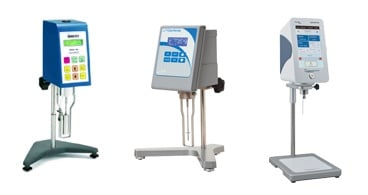
You probably know that rotational viscometers work by measuring the torque on a vertical shaft that rotates a spindle. The spindle is in the test sample and its rotation is impeded in proportion to the viscosity of the sample. These instruments measure viscosity.
Read More
Topics:
Viscometers,
Viscosity,
Liquid Properties
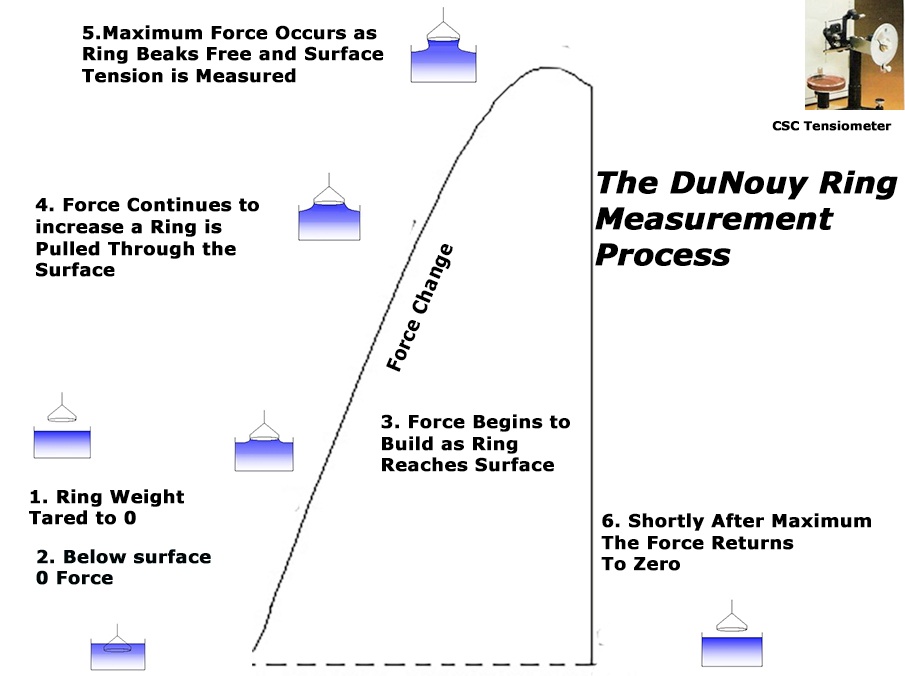
An understandable definition of surface tension: “The attraction force between molecules at the surface of a liquid. The force that keeps if from flying off into space”.
Read More
Topics:
Tensiometer,
Surface Tension Measurement,
Surface Tension,
actual surface tension,
apparent surface tension,
Liquid Properties
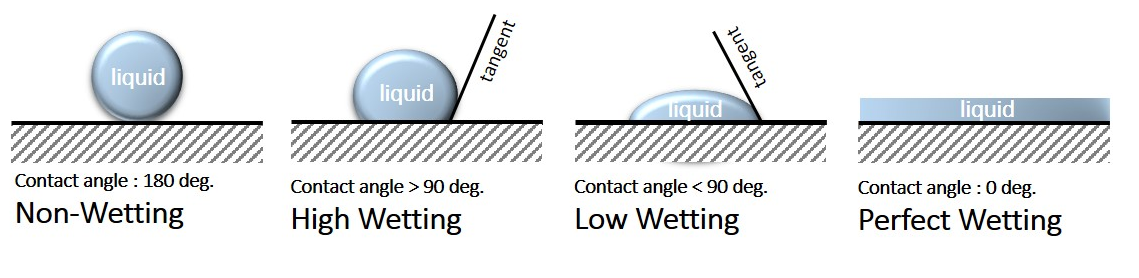
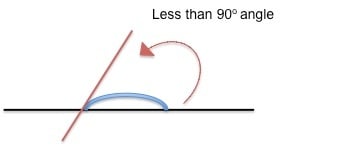
Contact angle and surface tension. The two terms are never far apart. Run a Google search of "contact angle" right now and see for yourself. You'll often see the terms mentioned within a breath of one another because contact angle and surface tension are two approaches to surface analysis - the study of how a surface interacts with other materials or components. Generally speaking, there is also a relationship between the two measurements, one that tends not to be very clearly explained in other resources. I hope to remedy that today.
Read More
Topics:
Automatic Surface Tension Measurment,
Surface Tension Measurement,
Surface Tension,
contact angle,
contact angle meter,
wettability,
Liquid Properties
When we first started measuring moisture with Karl Fischer, I was instructed in the complex chemical reactions involved. I was also was told that the process was skittish.
Read More
Topics:
Coulometric Karl Fischer,
Volumetric Karl Fischer,
Moisture Testing,
Karl Fischer,
Karl Fischer Titration,
Moisture
For several years, people in the test sieving business have been grousing about the difficulty of making sure that a test sieve certification is what they need. Anyone who is working with close tolerances in the smaller particle sizes, like 300 microns and smaller, have serious issues in matching results from test sieve to test sieve.
Read More
Topics:
Mid-Point Sieves,
Calibration,
Sieve Calibration,
Sieve Certification,
Sieve Testing,
Sieves,
Sieve Analysis
One quiet night, long ago I was musing over moisture analysis and how easy it is to do using Loss-on Drying (LOD). Little did I know what was in store.
Read More
Topics:
Bound Moisture,
Moisture Analysis,
Moisture Testing,
Loss-On-Drying
Five years ago, we published an article on in-line vs. off-line moisture measurement. At that time we debated whether these measurement systems should be called on-line or in-line. We chose to use the term "on-line". Since then, however, the world of the internet became known as "online". So, to avoid confusion, we changed our view and now refer to direct measurement as "in-line" moisture measurement.
Read More
Topics:
Moisture Analysis,
Moisture Testing,
Loss-On-Drying,
In-Line Moisture Measurement
If you take Sieve Shakers for granted, you may be surprised to know that the selection of the right shaker can have a profound effect on your sieving results.
Read More
Topics:
Sieve Shakers,
Particle Size Analysis,
Sieve Analysis
Nearly every day we have a question about differences between Viscosity, Consistency and Surface Tension. There is usually a second part of the question;
Read More
Topics:
Viscometers,
Viscosity,
Bostwick Consistometer,
Tensiometer,
Surface Tension Measurement,
Surface Tension,
Liquid Properties