Read More

Topics: Free Moisture, Moisture Testing, CSC Digital Moisture Balance, Moisture

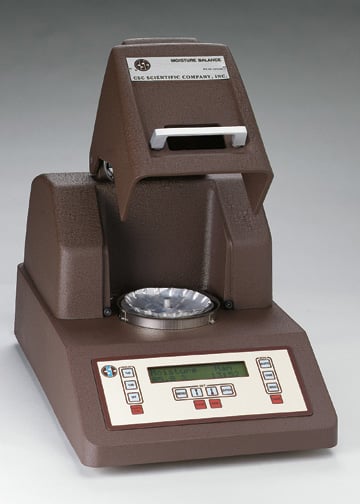
Regularly I’m asked the question; “How accurate is this moisture balance?”
The questioner asks for the answer in terms of percent (%) moisture. When I answer “it depends”, I always get the unspoken response, “Why did I ask this stupid idiot?”
When inquiring about the precision of measurements such as weight or temperature, the responses are clear-cut and tied to the accuracy of the instruments. For instance, 25 grams or 50 degrees with a margin of plus or minus (+/-) 0.1 gram or 1/2 degree.
When questioning the accuracy of your percentage reading, the answer can be quite complex. This complexity arises from the fact that percentage (%) is a relative measurement. Take, for example, the outcome of a Loss on Drying (LOD) moisture test, which is heavily influenced by the size of the sample used.
To better grasp this concept, consider how the result of an LOD moisture test is derived. It involves subtracting the weight of the sample at the end of the test from its initial weight, and then dividing this difference by the original weight of the sample. This calculation ultimately yields a % moisture reading.
The upcoming analysis will shed light on the impact of both sample size and instrument precision. We will delve into a sample containing 23.5% moisture, examined using an electronic LOD moisture balance with a sensitivity of 0.001 grams and a repeatability of +/- 0.005 grams.
Topics: Moisture Analysis, Moisture Testing, CSC Digital Moisture Balance, Loss-On-Drying, Moisture, moisture balance, instrument accuracy
Regularly I’m asked the question; “How accurate is this moisture balance?”
The questioner asks for the answer in terms of percent (%) moisture. When I answer “it depends”, I always get the unspoken response, “Why did I ask this stupid idiot?”
When you ask about the accuracy of something like weight or temperature the answers are straight forward and relate to the instruments' precision. For example 25 grams or 50 degrees plus or minus (+/-) 0.1 gram or 1/2 degree.
When you ask the question of how accurate is my percentage reading, the answer becomes complicated. It’s complicated because percentage (%) is a relative term. For example, the answer for the result of a Loss on Drying (LOD) moisture test, is based on the size of the sample you use.
Using the example of a LOD moisture test we can understand the concept. The result of this type of test is calculated by subtracting the weight of the sample at the end of the test from the weight of the sample at the beginning of the test. This difference is divided by the initial weight of the sample. This procedure produces a % moisture result.
In the following analysis, the implication s of sample size and instrument precision will be illustrated. This will be based on a sample that has 23.5% moisture and an electronic LOD moisture balance that has a sensitivity of 0.001 grams and repeatability of ± .005 grams.
Topics: Moisture Analysis, Moisture Testing, CSC Digital Moisture Balance, Loss-On-Drying, Moisture, moisture balance, instrument accuracy
Topics: Moisture Oven Test, Moisture Analysis, Moisture Testing, CSC Digital Moisture Balance, Loss-On-Drying, Moisture, fast moisture test, moisture balance, moisture content, moisture measurement

A question we get a lot is:
Of course, the answer is often “it depends”, and the method does depend on the chemical and physical composition of the product. There are several methods used to determine moisture content: Loss-on-Drying (also known as Weight Loss), Karl Fischer, NIR, and Radio Frequency.
Topics: "Ask Art", Moisture Analysis, Karl Fischer, CSC Digital Moisture Balance, Loss-On-Drying, Moisture
CSC Scientific Company, Inc
2799-C Merrilee Drive
Fairfax VA, 22031
800-621-4778
703-280-5142 (fax)
csc@cscscientific.com
No part of this page or any other page in this site may be copied or reproduced in any way.