

Holy grail and Sieve Calibration
- Is your concrete going to be strong enough?
-
Will you chocolates taste right?
-
Will your washing powder flow and dissolve as advertised?
-
Is there dangerous residue in your pill stock?
-
Will the “frack sand” keep the fractures open?
-
Is my salt of the correct grade?
If these are not correct, serious consequences could result (e.g. spoiled product, returned batches, rework or scrap).

These are the particle-size issues for which we test, frequently using woven wire mesh sieving techniques. For a long time, I've made sporadic attempts to understand how to ensure that tests really represent particle distribution. Many phenomena can affect these determinations.
Inherent Irregularities
I have decided to undertake clarifying this murky process. There are inherent irregularities in most woven materials. Regarding woven wire mesh used in sieves, standards organizations attempt to determine the acceptable range of these irregularities and then set acceptable variation limits.
Mesh problems also arise from the testing process as well as cleaning and various forms of abuse. How do we determine if these processes affect sieve performance?
Here Comes Pequeño
By means of illustration, I offer a particle’s perspective, the particle which I've named Pequeño. He encounters a sieve, undergoes a test, is cleaned out of an undersized hole and attacks several calibration operations.
Pequeño is doing this in four episodes, the first of which we will explore now and the others in later blogs:
-
Bouncing around in a test
-
Getting cleaned
-
Beating the calibration
***
Certification
I am Pequeño, a particle with a passion to get through any sieve and not be amongst the particles retained.
My story begins as I observe Brad, a professional sieve certifier, at work squinting through a microscope at a series of nearly square openings bounded by sections of wire that span the entire sieve. In one direction, the wires go straight across the sieve (Weft). In the other direction, the wires alternately go over and under the straight wires (Warp).
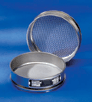
I'm from a large family of very small (about 150 micron) siblings. Brad is working on a number 100 8-inch diameter sieve with 150-micron nominal apertures, holes or openings (they can be called any of these). It has about 500,000 of these openings. It should be easy for me to migrate to the next sieve.
Brad Certifies
Brad is inspecting and measuring 200 of these holes (about 0.04% of the total). He is measuring the wire in each as well as one side along the weft and one side along the warp. When finished, he will apply ASTM-specified formulae and determine if the sieve meets specifications.
Within the acceptable specs for these 200 openings, the average could be as large as 156.6 microns. There should be no problem of my getting through openings that size. However, this average could be as low as 143.4 microns.This could finish me, but the other specified dimension is the 193-micron maximum allowable size of an individual opening.
If I look around enough, I should even be able to get through a sieve that Brad calculates as the minimum. Remember, Brad only measured 1-in-2500 openings.
If his task was to certify that the sieve meet the highest standard -- the Calibration Sieve Category -- he would apply a reasonably tight standard deviation to his measurements. This would reduce my chances of getting through on the small average, which would only make it more of a challenge to find an opening through which I can pass.
In fact, I even have a shot at getting through a sieve with the next smallest designation (number 120 with 125 microns nominally sized holes). The allowable maximum of any individual hole measured can be 168 micron -- an easy transit for me.
I like the theoretical odds of feeding my passion of getting through my size and smaller sieves (hate to be in the retained category). In fact, I might even nvite some of my larger siblings to join me.
In my next visit, I'll take you with me on some real production tests that use the sieve that Brad measured and professionally certified.
Check out the next article here Will Certification Lead to the Holy Grail of Sieving?
Until then,
Pequeño
Back to world of real People
I hope you found this entertaining and somewhat informative. Share it with your associates if you do.
Thanks for your attention, I remain distracted, mystified but still swinging,
Art
P.S. Check out sieve alternatives and get a bit of basics on sieves

P.P.S. If you would like to get a notice when we try to clear up more of our self devised enigmas, subscribe at the upper right of this piece.
