CSC Scientific Blog

A blog about test equipment

Subscribe in a reader

Subscribe via E-mail

Your email:

CSC Scientific Blog

Current Articles | RSS Feed RSS Feed

Certify Sieves or Calibrate Sieves --- Should You Do It?

  | Share on Twitter Twitter | Share on Facebook Facebook | Buzz This  Google Buzz | Submit to Digg digg it |  Add to delicious  delicious |  Submit to StumbleUpon StumbleUpon |  Share on LinkedIn LinkedIn |  Share On Technorati Technorati | Submit to Reddit reddit 

Certify Sieves or Calibrate Sieves ?     The relative value of a sieve certification process vs a sieve calibration has perplexed me for a long time.

Eventually it dawned on me that the entire certification process is an insurance policy of sorts. Firstly, it confirms that the mesh is within the ASTM or ISO spec -- even though the spec allows for significant variation. Secondly, it meets the traceability demands of ISO mandates.

However, the inspection reports only minimally predict a sieve's performance. I recall a situation in which a customer with a high-powered QC program had trouble matching the performance of Mid-point Certification Reporta new shipment of mid-point sieves. [Mid-point sieves must conform to a much tighter tolerance than the standard spec.] After an exhaustive investigation, the old batch of sieves was determined to be at the low end of the spec while the new ones were at the high end. The mid-point certification reports did not indicate this discrepancy.

The customer then used a procedure that compared the performance between the two batches. That process finally pinpointed the problem. This is what I think calibration is all about -- ensuring predictable performance in an operating environment.

Calibration techniques vary from comparing a sieve result with a master set of sieves (Master Stack) to comparingMaster Sieve Strack result with a known sample (Master Sample). Both of these techniques are application-specific.

Another approach to calibration involves utilizing calibration spheres or beads, which compares a specific sieve's performance to a traceable high-precision standard. It provides a result as a single specific quantitative measure of the expected sieve performance. The result is a mean sieve opening size.

Given that the high-precision beads are traceable to an ISO-recognized standard, this calibration method serves the ISO Sieve Certificationinsurance purpose of meeting ISO or internal company QC audit demands. Unlike the certification report, a calibration using this technique also yields a single performance indicator. In most circumstances, using the calibration bead method eliminates the need to use Master Stacks or Master Samples.

Whitehouse Scientific has a process that provides a sieve calibration that results in a mean sieve size to approximately +/- one micron. It took them approximately three years to develop their traceable calibration process. For more on this see Sieve Calibration

I hope this rant stimulates some questions and discussion.

Thanks for reading this.

A still perplexed,

art


View from Inside a Karl Fischer Titration Cell.

  | Share on Twitter Twitter | Share on Facebook Facebook | Buzz This  Google Buzz | Submit to Digg digg it |  Add to delicious  delicious |  Submit to StumbleUpon StumbleUpon |  Share on LinkedIn LinkedIn |  Share On Technorati Technorati | Submit to Reddit reddit 

 When people are looking for a way to measure small amounts of moisture, we often recommend the Karl Fischer method.

The first question many ask is
"What is Karl Fischer?"
The second question usually is
"How does it work?"

I thought it might be interesting to answer the second Karl  Fischer Titration Vesselquestion from the perspective of actually being inside the Karl Fischer Titration Cell.

First, I climbed into a jar that has four openings at the top.

 Through one of theKarl Fischer Generator Electrode openings, an operator pushed a glass tube with a funny kind of mesh at the bottom. They call this the Generator.

Next, through another opening, they push a second glass tube that has wires sticking Karl Fischer detector Electrodeout of the bottom. They call this the Detector.

Sitting at the bottom of this jar is a little rod, which they call the Stirrer.

Comfortably sitting on the stirrer rod at A Karl Fischer Stirrer Rodthe bottom of the jar, I observe an operator pouring a liquid into the top of the generator above the funny mesh.

Then, they tell me to be ready to swim as they fill the main part of the jar about halfway with another liquid they refer to as the Reagent. As I'm treading water in this reagent, they seal off all the openings so they are air-tight.

They yell down that they are going to start clearing out all ofInside Karl Fischer Test the moisture from inside the jar. The stirrer bar starts spinning, causing chaos in the reagent. I feel like I am in a Waring Blender.

As I'm bouncing around the jar -- or as the operators call it the Titration Cell -- they tell me to be ready for a little shock. They turn on the machine and the detector says, "Hey! There is water in here. Push some electric current into the cell." Zap Zap Zap.......

The maelstrom starts to turn yellow. What is this? It is a whole bunch of Iodine; the very same substance you used to put on a cut finger.

They tell me that the shock I felt caused the Reagent to produce the Iodine. Apparently, the Iodine reacts with the water and gets rid of it.

By that time, the detector says, "Water's All Gone" and they turn off the stirrer. I'm almost drowned.

An operator yells down, "Here comes a real test!" The dammed stirrer starts and I'm in the blender again.

NKarl fischer  syringeow I see the business end of a syringe - the needle. The syringe pushes the sample to be tested into this chaotic whirlpool in the cell and the shocks start again. Zap Zap Zap... The detector found water.

I'm racked with shocks for a minute or two and the yellow returns. The Iodine does its job and the detector says, "No More Water."

The shocks stop. The test is over. The operators shut down the stirrer and pull me out --- totally waterlogged. Or should I say reagent-logged?

The machine measured the amount of shock it took to generate enough Iodine to get rid of the water. All of this was done just to measure a few micrograms of water.

I hope you found this amusing and maybe a little informative.

By the way, I am never going inside a Karl Fischer Titration Cell again.

A very soggy Art


Static Electricity and Sieves: No Problem -- Maybe

  | Share on Twitter Twitter | Share on Facebook Facebook | Buzz This  Google Buzz | Submit to Digg digg it |  Add to delicious  delicious |  Submit to StumbleUpon StumbleUpon |  Share on LinkedIn LinkedIn |  Share On Technorati Technorati | Submit to Reddit reddit 


I'll bet that most of you have experienced the shock of walking onstatic electricity shock a thick wool rug on a dry winter's day and getting zapped out of your reverie when reaching for the metal door knob.


The same process of static electricity generation can play havoc with your sieving process.

"Static electricity" (also called charge separation) occurs whenever four conditions exist:

1. Humidity is fairly low
2. Two surfaces are touched together, then separated
3. The surfaces are made of two different materials
4. Both surfaces are electrically insulating

For many products -- particularly hydrocarbon-based materials, plastics, reactive metalsTest sieves, paint pigments and powders with a large fraction of fines -- the sieve action provides a fertile environment for charges to build up on the particles and sieve components. This causes clinging, agglomeration and blinding. In other words, as material bumps and bounces around in the sieve stack, they generate that same type of electrical charge that zapped you last winter.

So what to do?

There is a sure, but messy (and a pain-in-the-butt) solution.

Wet Sieving

In wet-sieving, the separation of fines wet wash test sievesfrom the coarse portion of a sample is done while it is suspended in an aqueous solution introduced to each test sieve.

The liquid is used to negate static charges, break down agglomerates and lubricate near-size particles.

After the fines have been washed through the sieve, the residue is oven-dried and re-weighed.

---- Difficult, but effective.

Anything Easier?

A material that makes the particles slippery can be added to the sample, such as silica, activated charcoal, talc, magnesium carbonate, tricalcium phosphate or silicon dioxide.

If you make thehigh voltage power lines optimal selection, the sample stops being an electrical generating plant as well as an agglomerator. It goes through the sieves and gets the desired result.

The problem is, you have to know the additive's size and adjust your results by the amount of this material that is retained.

----- This is another fix but it is still a pain.

A simple approach that might work.

Perhaps strips of anti-static sheeting , such as those used in your clothes dryer will work. This is as easy as putting a few strips in at least the small mesh sieves.

If this is effective, it is the simplest solution we know.

Static Electricity and Sieves

Yet again -- one of Nature's ways to make a simple process difficult.

Please let me know if you've found any other effective solutions to a static problem in your sieve testing.

Thanks,

Art


Is My Test Equipment Lying?

  | Share on Twitter Twitter | Share on Facebook Facebook | Buzz This  Google Buzz | Submit to Digg digg it |  Add to delicious  delicious |  Submit to StumbleUpon StumbleUpon |  Share on LinkedIn LinkedIn |  Share On Technorati Technorati | Submit to Reddit reddit 

I keep running into this kind of thing.

There is a recurring question we are asked as instrument manufacturers:

"Is my equipment working OK?"

This is of particular concern when a production process seems to be off standard.

Mad QCQC says: "Clearly Process Problems" cool production

Production says: "Bad Test Results"

These challenges arise often.

What to do?

Must we call in our outside certifier, send it to the manufacturer for calibration and/or run it on a known standard? What else can resolve this issue? Most of the solutions can take hours if not days to obtain. With a measure of analysis, equipment know-how -- and a bit of diplomacy -- the dilemma can be resolved on-the-spot.

The first option is a quick test to determine if the equipment is working properly, which answers the questions:

Is the Instrument Lying ?
Is QC right or is Production right?

Another major annoyance is when results don't seem to match between instruments of the same type. The initial conclusion is that all but one is lying, but which one?

Run the quick test to determine if each instrument is working properly. If a problem is found in one or more, the answer is fairly clear.

If all instruments pass the quick test, we are then confronted with a mystery that impels further investigation:

  • Are the testing environments different? 
  • Are the product samples identical? need a  magician
  • Are the test parameters the same? 
  • Can the differences be duplicated with different operators?

If answering these questions do not resolve the mystery, it is clear that we are being lied to by one or more of the instruments. However, we must keep looking for some outside influence. ---- Need we find someone who can perform magic?

Yet another challenge arises when multiple labs are convinced that a test instrument is lying about given results. This can happen when the Corporate R&D people, a new outside lab or new QC staff determine that an industry standard test will be needed for samples. Frequently, this test will be off-site or the results will take hours if not days to obtain.

This is a major quandary.

We are faced with issues that require careful analysis of testing method differences, product sample reaction to these differentShamrock methods, environmental differences between test locations and strongly biased opinions. Finding rational answers to the "Is my instrument lying?" question is tough. A bit of luck is always welcome.

I would like to hear of your experiences with Lying Test Equipment and how you solved these problems. Comment about that here or email me at artgatenby@cscscientific.com.

I will share these experiences in future rants.


Art

P.S. These kinds of things happen for Moisture, Particle Size and Surface Tension  instruments.  No area of measurement escapes the question: Is My Instrument Lying to Me?


Re-Certify Mid-Point Sieves? When and How?

  | Share on Twitter Twitter | Share on Facebook Facebook | Buzz This  Google Buzz | Submit to Digg digg it |  Add to delicious  delicious |  Submit to StumbleUpon StumbleUpon |  Share on LinkedIn LinkedIn |  Share On Technorati Technorati | Submit to Reddit reddit 

I recently had a long conversation with the person [we'll call him Bill] responsible for setting up the quality procedures for very tight specifications in a new process -- part of which was developing procedures for checking the ongoing tolerances of production sieves.

Bill planned to utilize a master stack of mid-point sieves for this purpose. He wanted to know how he could calibrate the stack.

The tolerances for these mid-point sieves are better than ASTM or ISO standards. In fact, they are selected because they fall in the middle of the standard (hence the name mid-point sieves.) They include a detailed report of the measurements that serve as the baseline calibration.

Bill's next concern was how to maintain assurance that the sieves in the master stack maintained the original tolerances. In common practice, the master stack is only used to check production or working sieves after many production tests or if aberrant results are detected. Bill recognized this, but wanted to know when and how the master stack should be checked.

The following rules of thumb for checking sieve calibrations can serve as a guideline:

  Number of Tests Number of Tests    Time
 425 Micron (#40) to 12.5 millimeter        60 to 80
  2 to 3 Years 
 106 microns (#140) to 355 microns (#45)             50
   18 Months
 45 microns (#325) to 90 microns (#170)             30
   12 Months
 20 microns (#625) to 38 microns (#400)             20
     6 Month


Based on the production rates, the timing of master stack calibration checks may be estimates. Similarly, the need for checking the master stack sieves can be determined.

When a master stack sieve sieve calibration standardsneeds to be checked, a recertification using Sieve Calibration Standards can be performed.

Additionally, sieve manufacturers and several sieve distributors conduct this process using optical comparators. A new recertification service is available using video and image analysis technology. It costs $50 to $60 per sieve.

Considering location and security, Bill asked if the equipment needed to apply these techniques was readilysmall Optical Comparator available. The answer is yes. There are small optical comparators costing a few hundred dollars that can measure a small number of sieve openings at a time. Bench top comparators costing $3,000 to $10,000 are suitable for viewing andOptical comparator measuring a larger number of sieve openings. Video/image analysis systems start at $20,000 and automate the test sieve recalibration process.

In summary, the calibration cycle of master stack mid-point sieves should be established based on the quality control precision standards of your company. Further, the number of working sieve calibration checks made against the master sieve stack is the basic determinate of when master stack sieves should be checked. Recalibration services are readily available in most industrialized areas. As an alternative, calibration standards and a range of equipment are available for in-house recertification and calibration.

I hope you found this useful.

Warmest regards,

 Art


Is Your Moisture Test Result Really Moisture?

  | Share on Twitter Twitter | Share on Facebook Facebook | Buzz This  Google Buzz | Submit to Digg digg it |  Add to delicious  delicious |  Submit to StumbleUpon StumbleUpon |  Share on LinkedIn LinkedIn |  Share On Technorati Technorati | Submit to Reddit reddit 

A short ramble.

Most of us think about measuring moisture by...

  1. Drying the material and measure the weight loss 
  2. Using a calibration and electronic instrument 
  3. Using a titration method such as Karl Fischer

When using these processes, we take for granted that the results will be the product's actual moisture.

Not always so.

Recently, I was reading about a procedure the Brazilian Agriculture Ministry (BAM) developed to get a very, very tight tolerance moisture determination for coffee beans.

The BAM procedure specifies placing the coffee beans in an oven for a long time -- 104° C for 24 hours. This test was the standard against which all other coffee moisture determination methods were compared.

However, it was found that significant amounts of other volatiles were being released during the 24-hour process, which resulted in higher-than-expected moisture readings. The oven test standard thus over-stated the actual moisture.

The BAM also used an oven method using ground beans CSC Digital Moisture Balanceand an infrared loss-on-drying instrument. As you may know, the grinding process frequently causes moisture loss.

In addition to two oven methods and the infrared loss-on-drying instrument, a Karl Fischer Titration was used. The Karl Fischer Titration measures only moisture and eliminates the effect of volatiles. Because the coffee beans need to be dissolved in a solvent media, the beans had to be ground -- thus inducing the aforementioned grinding error to this moisture analysis.

(If an evaporator oven had been used in concert with the Karl Fischer Titration, the whole beans would have been heated to a high temperature. The volatiles and moisture would then have been extracted and the residual gas collected in the Karl Fischer unit. Only the moisture would be measured using this method, thus eliminating the grinding error.)

The moisture range in the beans tested was 4.2% to 13.5%. Based upon these analyses, two significant inferences were made:

1.The effect of volatiles evaporating is more significant as the moisture levels decrease. This indicates that volatile material amounts tend to be the same at all moisture levels, thus representing a greater weight loss proportion for lower moisture samples.

2.Grinding causes moisture loss, which becomes a greater proportion of the total for lower moisture samples. In these lower moisture samples, it was found to be more significant than the volatiles.

Most of our solids moisture measurement applications are low volatile situations. When grinding is needed, the processes usually have a wide enough tolerance to not require grinding loss corrections. Even though most of you do not have to contend with this kind moisture test adjustment, I thought you would be interested in the implications of these factors on the true moisture level in a sample.

Let me know if you have questions or comments.

Warmest regards,

Art


Biomass As Fuel — Now Subsidized

  | Share on Twitter Twitter | Share on Facebook Facebook | Buzz This  Google Buzz | Submit to Digg digg it |  Add to delicious  delicious |  Submit to StumbleUpon StumbleUpon |  Share on LinkedIn LinkedIn |  Share On Technorati Technorati | Submit to Reddit reddit 

The Biomass Crop Assistance Program (BCAP) provides, according to the USDA’s Farm Service Agency, funding to producers of “eligible biomass material” that can be delivered to “designated biomass conversion facilities for use as heat, power, biobased products or biofuels.”

About a month ago, one of our customers told us about his need to measure biomass material moisture for this program. Given our specialization in all types of moisture measurement, we consider the BCAP Program to be of particular interest.

Mixed Biomass

The program essentially subsidizes biomass material collectors and producers. When selling it to a user (referred to as a BCAP conversion facility,) they receive a subsidy for each ton of material sold. This may at first seem to be a very simple proposition but, as with most endeavors, there are unanticipated challenges.

One biofuel that has been known for many, many years is Hog Fuel. It is not different from most of the biomass material accepted under BCAP, except that the BCAP subsidy is based on dry weight tonnage. The implications are that each load of biomass material needs to be weighed — as it would be in a Hog Fuel program. However for BCAP, the load’s moisture needs to be established, then a consequent weight adjustment has to be made for a proper subsidy determination.

Prepared Biomass Biomass loads may contain sawdust, wood chips, bark or round wood (e.g. small logs and branches) all of which contain moisture. This diversity creates a series of moisture measurement issues. Moisture from small material like wood chips and sawdust can easily be measured in several different ways, such as loss on drying, capacitance methods, radio frequency methods, etc.

Moisture determination becomes much more difficult with large chips and complex mixed loads. There are no easy universal answers. This is particularly difficult when the incoming biomass material consists of round wood of all sizes and shapes.

The responsibility for this determination falls upon the BCAP conversion facility?.

I thought you’d be interested in knowing or learning how a government program designed to alleviate our energy challenges by using biomass material, creates a serious side problem — in this case how to measure material moisture in a way that conforms with the prescribed specifications.

Let me hear from any of you who are facing this problem and please feel free to propose solutions. So far, I’ve heard things ranging from doing overnight oven tests to negotiating figures with the biomass supplier. I’ll be very interested in your input.

Warmest regards,

Art


New ASTM E11-09 Sieve Standards — Exciting or Just Dull ???

  | Share on Twitter Twitter | Share on Facebook Facebook | Buzz This  Google Buzz | Submit to Digg digg it |  Add to delicious  delicious |  Submit to StumbleUpon StumbleUpon |  Share on LinkedIn LinkedIn |  Share On Technorati Technorati | Submit to Reddit reddit 

I have often ranted about the limited range of ASTM 11 sieve mesh standards as it relates to individual sieve certification. We at CSC have tried to help clearly distinguish between different levels of inspection and/or degrees of conformity. We outlined three levels of sieve certification. These are working sieves, mesh certified sieves and mid point sieves. There are summary definitions of these categories on the CSC Web site.

In June of this year, the ASTM E-11 committee, published a revised standard for test sieves. Among other things, it tightened up the specifications on maximum opening size. In addition, the new standard changed the way the specification is defined. It also provides a standard and definition for three levels of mesh certification. These levels are named: Compliance Test Sieves, Inspection Test Sieves and Calibration Test Sieves.

In addition to detailed specifications of the construction of test sieves the ASTM E11-9 defines the following characteristics of the three compliance levels:

  1. Compliance Test Sieves – This level states that thesieve cloth (mesh) was inspected prior to mounting in the sieve and that the cloth meets the requirements of the standard. Part of the standard for a Compliance Test Sieve is that the standard deviation of the openings measured will not exceed that for a confidence level of 66%. The certification document does not require any statistical documentation.
  2. Inspection Test Sieves – In these sieves, the cloth(mesh) is inspected after mounting in the sieve. The Inspection Test Sieve must have a standard deviation of the openings measured that does not exceed the number needed for a confidence level of 99%. An inspection document shall be included that states at a minimum, the value for the average aperture size, separately in both the warp and shute direction of the sieve cloth.
  3. Calibration Test Sieves – In these sieves the cloth (mesh) was inspected after mounting in the sieve. The inspection standard for this sieve requires that the standard deviation of the openings measured does not exceed that for a confidence level of 99.73%. A Calibration Test Sieve certificate shall include at a minimum, the number of aperture and wire diameters measured, the average aperture size, standard deviation and average wire diameter, separately in both the warp and shute directions of the sieve cloth.

Because current sieve definitions and calibration standards are based on older definitions and certifications, it may be some time before these newer tolerances and definitions are instituted in the field. Further it will take sieve manufactures time to switch their processes to these newer definitions and certifications.

The changes stated in ASTM E11-09 have defined the specific measurement and calculation details that define three confidence or assurance levels for test sieves. I would expect that over time these new standards will replace the current less defined variations.

Let me know what you think will happen. Do you think this is a good change?

Warmest regards,

Art


Walk On Water ??? Really ???

  | Share on Twitter Twitter | Share on Facebook Facebook | Buzz This  Google Buzz | Submit to Digg digg it |  Add to delicious  delicious |  Submit to StumbleUpon StumbleUpon |  Share on LinkedIn LinkedIn |  Share On Technorati Technorati | Submit to Reddit reddit 

Yes you can walk on water with Surface Tension.

I am frequently asked about surface tension : what it is all about, why it’s important, what it does and how it applies to different substances.

I find that definitions of surface tension range from the simple:

Surface tension refers to water’s ability to “stick to itself”.
to the more technical:

A liquid exists as a liquid because of the attractive forces between molecules. These are called intermolecular forces or van deel Waals’ forces.

Molecules within the liquid are surrounded by other molecules and are attracted in every direction with equal force. Molecules exposed to the surface are unstable because of the attractive forces are not equal and they are drawn away from the surface. As a result the liquid tends to contract the surface area until the equilibrium is reached.

That happens when the surface reaches its minimum.
These intermolecular forces which contract the surface are called “Surface Tension”.

Now about water walking.

Many bugs do it. Here is a picture of a happy Wasp and a struggling Wasp. As the temperature of water increases surface tension goes down — the force between molecules becomes less. The bug will begin to sink like the wasp on the right.

Like the bug a paper clip will float given the right surface tension. If the temperature starts to go up like the Wasp, the paper clip will begin to sink.

Consider the opposite. Surface tension increases as temperarure goes down. A lower temperature creates more force holding the molecules together. When it becomes ice you can walk on it even skate on it.

Aside from a few bugs and ice skaters who cares about surface tension?

Soap and detergent manufacturers do. Their products lower surface tension so that dirt can be washed out.
Ink, paint and coatings producers are very sensitive to surface tension because it determines how their product reacts with the paper, or a wall or a plastic bag.
The form of your medicine has a lot to do with the control of surface tension. It is a factor in production of liquid drugs and in many pills.
The measurement of surface tension can also define the cleanliness of water. It can be a measure of trace impurities. These users are a sample of who else cares about surface tension.

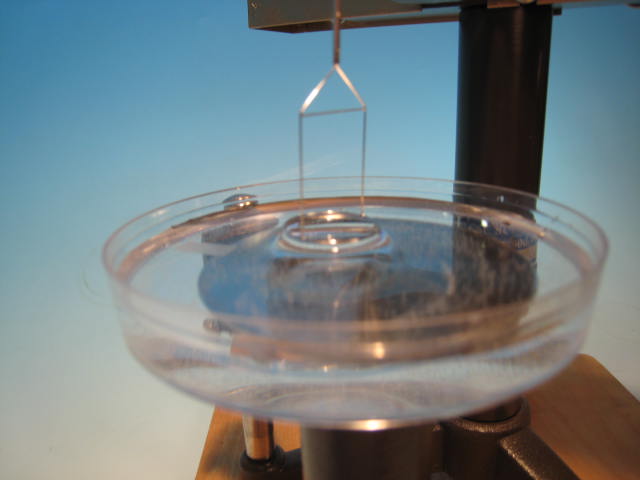
We make instruments that do these measurements. They are called Tensiometers.

In future musing or rants I’ll describe some of the techniques used to measure surface tension.

I hope this has been useful and entertaining.
Let me know if there are any test equipment issues you would like to hear about

Art


Bostwick Consistometer – Incline or Not

  | Share on Twitter Twitter | Share on Facebook Facebook | Buzz This  Google Buzz | Submit to Digg digg it |  Add to delicious  delicious |  Submit to StumbleUpon StumbleUpon |  Share on LinkedIn LinkedIn |  Share On Technorati Technorati | Submit to Reddit reddit 

The Bostwick Consistometer is used all over the World to check the quality of sauces and condiments. In our in-house training session we do blind product tests and clearly define the differences between brand of ketch-up and mustard. This is a testament to the value placed on Bostwick Consistometer tests by the top food manufacturers.

We continually get questions about set-up of the consistometer. It is very simple to operate. Consequently, questions about set-up and theory of operation are often given short shrift.

But first I’ll go through the operation and conduct of a test. The simplicity of operation is shown in these illustrations.

The Consistometer is built around a trough approximately 14 inches long. There are marks one-half centimeter apart along the bottom of the trough. These marks are sometimes referred to as Bostwicks. About two inches from one end is a spring loaded gate. The gate can be closed and a notched lever holds it in that position until released by pushing down on the lever arm.

The closed gate forms a small reservoir behind it.

To run a test, first you close and lock the gate with the lever arm in the up position.

Now it’s time to pour in the sample. Fill the reservoir up to the top of the gate.

The next step is to release the product by pressing down on the lever arm . Allow the product to run through the trough for 30 sec.

Observe how far the product traveled down the trough in the 30 sec.

The trough has gradation marks indicating the distance in centimeters. Record this value as the consistency of the product.

Now that you see how simple the test procedure is, I’ll give a little theory about what the test really measures. Consistency is a measurement of how a material flows against itself because the force of gravity. Sort of like sagging. Therefore, when the gate is released the sample begins to sag and drifts down the trough. The distance it travels in fixed length of time is know as its consistency.

In our training case, in 30 seconds a thicker mustard will travel less distance than a thinner mustard. Thus the thicker mustard will have a lower Bostwick reading.

Now For A Source Of Confusion

The set-up procedures call for the Bostwick Consistometer to be leveled using the bubble level attached to the instrument. If it appears that the small front foot is bent the procedure is to place a small level in the trough and level that. Despite these instructions supplier companies and their customers often get in serious discussions about the angle that trough should set.

This confusion can be eliminated when you refer back to the discussion of what consistency is: Consistency is a measurement of how a material flows against itself because the force of gravity. Sort of like sagging. Thus to have it sag properly the trough must be level and not at an angle.

Even if you never have the occasion to measure consistency or Bostwicks, I hope you found this exchange interesting. You may never look at the supermarket sauce and condiments shelves the same again.

Until next time,

Warmest regards,

Art


All Posts

CSC Scientific Company, Inc
2799-C Merrilee Drive
Fairfax VA, 22031
800-621-4778
703-280-5142 (fax)
csc@cscscientific.com
Credit Cards CSC Accepts
No part of this page or any other page in this site may be copied or reproduced in any way.