In 2011 "Powder-Bulk Solids" published an article  comparing certification process veracity with a sieve calibration process using calibrated glass microspheres (or beads). The certification process merely indicates that a sieve mesh conforms to a standard that has a wide tolerance regarding mesh openings. It is performed on a small number of openings. On the other hand, calibration using the calibrated beads results in a number representing the mean opening -- a result generated by actually performing a test encompassing at least 80% of the mesh openings.
The problems outlined in the article are still dogging todays QC Managers
Given that the calibration process highlights the actual performance of a given  sieve, we recommended that QC departments switch to a calibration method to determine the suitability of the sieves used in tight-tolerance situations. This requires a different mindset from test sieve manufacturers as well as QC departments responsible for controlling sieve processes.
We recently had a real-life example of the the difference between actual sieve performance and certification statistics. A customer recently acquired four 45 micron (#325) ASTM certified sieves. Given that their manufacturing process was critical, they decided to check the four sieves with calibration beads. The results on each sieve showed a mean aperture of 49 microns. Because the certification spec allowed a variation of up to 3 microns in average opening size (allowing up to 48 microns in average opening) They returned the sieves to the manufacturer for re-certification. All four sieves passed. The customer also had them double-checked by an outside laboratory. Each of the four sieves tested the same; consistent with a real-world sample as well as bead calibration results.
What to do? --- Whom to believe? --- What ARE these sieves?
In light of this, let's consider the most recent ASTM specification (ASTM E 11-09). The customer's sieves were 8 inches in diameter, which represented 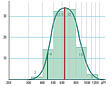 approximately 15 million openings. The most exact ASTM certification requires examining only 1,000 openings ---- less than .01% of the number in an 8-inch #325 sieve. For these 1,000 measured openings, the maximum allowable average opening size variation is 3 microns with an allowable maximum opening of 67 microns. Given that the bead calibration produced a mean opening of 49 microns, the customer felt that the sieve was out of spec compared to the maximum allowable average of plus three microns (45+3 ) of the observed 1,000 openings. Note that these statistics are all based on measurements and not on actual sieve test performance.
The bead calibration tolerance is about 1 micron in mean opening resulting from a sieve test using a calibrated sphere sample.
This real-life situation makes it clear that certification, while an insurance  policy of some value, does not predict a sieve’s actual performance. It does nothing more than sample some openings and determine if the sieve mesh is within prescribed tolerances.
Calibration performs a live sieve test and yields the actual results.This leads us to the conclusion that calibration with glass spheres is the optimal procedure for determining the suitability of a test sieve as well as checking and controlling a process.
We can compare mesh sieve performance to the results on the same  sample, but predicting it can only be accomplished by conducting an actual sieve test using a precise sample such as Calibration Beads.
To date, calibrated spheres are the best method for this and for determining the actual calibration of any test sieve.

As with most of the things I read about here, real world conditions often lead to confusion about theory and when analyzed question established practice.
I hope this has been helpful. Call me at 703-876-4030 if you want to discuss the certification/calibration dichotomy.
Art
P.S. Did you know that you can subscribe to these exposés, rants, raves and ramblings? All you have to do is jot your address in the box just to the right of the title.

P.P.S. Some Sieving History and a Primer for newbies to sieving. A Webinar.