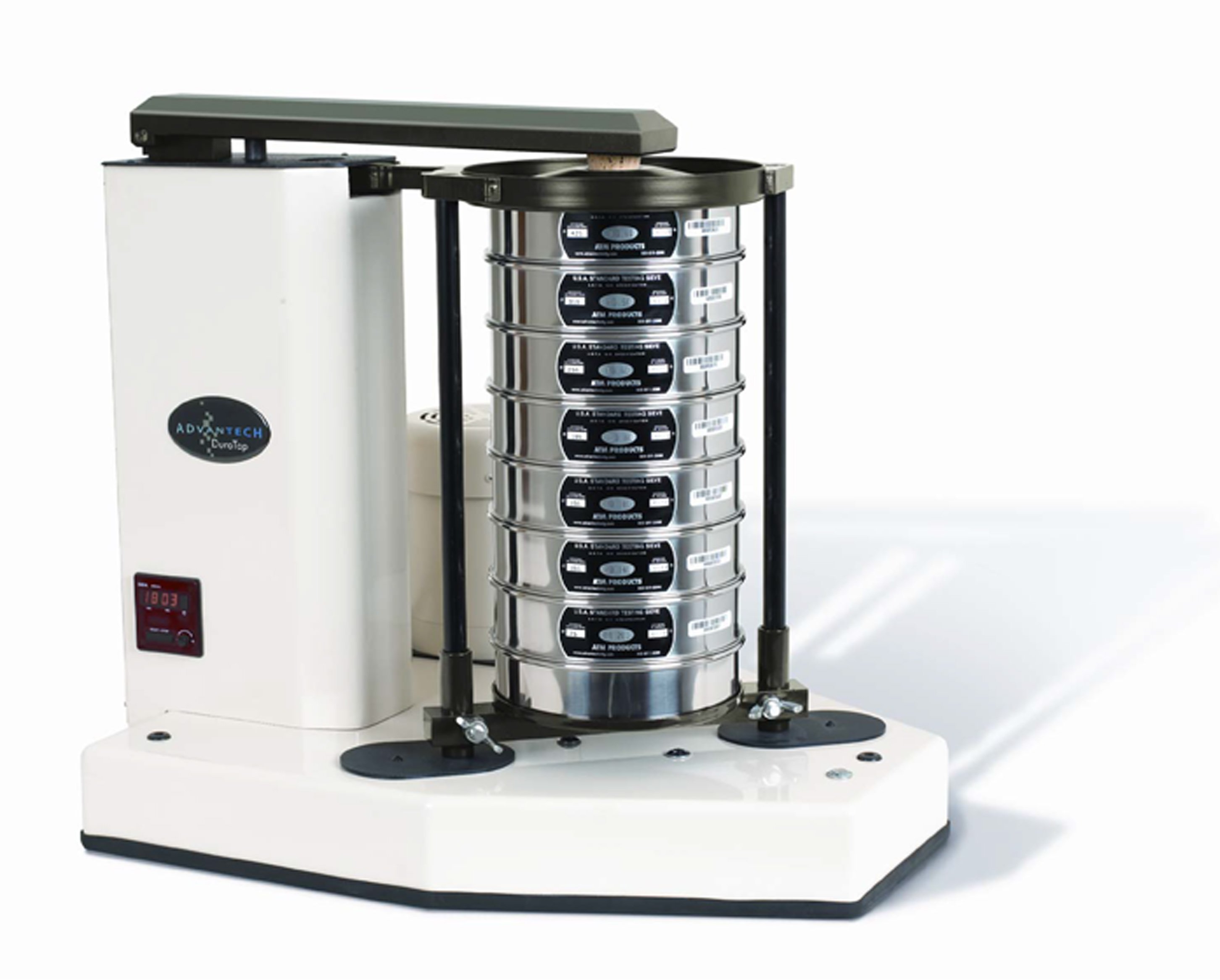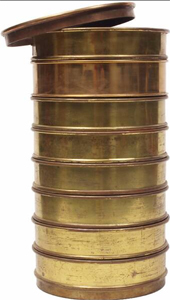
Hiram is a Quality Control Supervisor of a plant manufacturing specialty pellets. This is about his struggle with particle-size sieve testing and results analysis.
The principal quality factors of the product and process
are related to:
- Moisture of the raw material and of the finished product
- Finished material color
- Particle size distribution at the grinder output and of the finished product
Hiram’s responsibilities include testing each variable and comparing the results to the standards for each of five different products, which are produced in batches. Stan, the production Superintendent, expects Hiram to report any anomalies within one half hour of batch completion, to facilitate addressing problems before delivering pellets to customers.
The plant normally produces 15 batches a day. Sieve tests require a nine-sieve stack for grinder output and a six-sieve stack for process output.
Those familiar with pulling out distribution results form sieve tests will know the procedure well:
- - Measure and weigh a sample, record the weight
- - Load it and start the shaker
- - Wait 5 to 10 minutes.
- - Remove the stack and brush out the residue in each sieve on a balance
- - Record the weight.
- - Take each weight and divide by the total recorded weight.
If the procedure is performed correctly, the weights retained will equal 100%.
Weight collection and result calculation take between 10 and 15 minutes. Preparing and reporting these sieve results takes four to five hours a day.
Remember that Hiram needs to get the results to Stan within one half hour.
Like all of us, Hiram is under constant pressure to control his costs. Including all QC Tests, he
needs about 12 man-hours a day. The process is at the same time exacting, tedious and boring. He has one full-time person and must borrow an employee from another department for the remainder.
The borrowed person is changed frequently, which necessitates training both his full-timer as well as a new part-timer as needed. To minimize errors, Hiram must provide close supervision.
If one of his people is on vacation or sick, Hiram often must fill in personally.
The whole sieve analysis process was a pain. We can almost feel sorry for Hiram.
Is there more to the story?
Click here to see.
Still trying to figure it out,
Art
We are back with Hiram, the QC Supervisor in a specialty pellet plant.
We pick up the story after the QC department was hit hard by the flu season.
Not only was his main sieve tester out for an extended period, but the borrowed part-timer was also afflicted. He thus had to rely on temps, which made training a continuous process as well as exponentially increasing the level of required supervision. Hiram also found that he was increasingly performing the testing himself, taxing his abilities to perform his normal responsibilities.
Hiram began to wonder if there was a better way to accomplish his particle size sieve analysis.
Hiram then turned to Google.
He found some alternatives, including fully automatic systems, in which the sample is thrown in followed by a printed result. Considering the cost-control constraints mentioned in Chapter I, such a method was too expensive.
He did find a reasonable approach that eased weight collection and result calculation. The
meticulous residual sample weighing and removal from each sieve continued to be a part of the system. Still this was a considerable improvement from the previous method, requiring less training and supervision.
Hiram was glad that he had made the change. Business was growing, so extra batches were added each week resulting in the need for overtime. The extra tests were manageable as was the additional supervision. At least the calculations were consistent and reliable.
Now a new challenge for Hiram came roaring in. Business was so good that a new shift was needed. At least 2 ½ new people will require training and supervision.
Even if he convinces his trained full-timer to work this new night shift, he has to train a another set of people for the first shift with its attendant supervision issues.
Hiram figures he will be at the plant most nights to monitor the second-shift staff. Remember Stan still needs accurate results within ½ hour of each batch being completed.
What to do?
Go to Google again!!!
What did Hiram find this time?
Click here to find out.
I wonder what's next.
Art
The CSC Sieve Analyzer
The CSC Sieve Analyzer was designed to deliver a record of a sieve test results, eliminate operator error and significantly reduce the time to process and calculate these results.
History
Since ancient times until current days, outcomes of sieve tests have been recorded as the amount of material that is retained on each sieve used; usually expressed as the weight or percent retained. Some applications use the amount passed as an alternative.
The original process requires the emptying the material in each sieve onto a balance and recording the weight. These weights are used to calculate the retained amounts and percentages…. A tedious and error prone process.
Changes with the CSC Sieve Analyzer
With the advent of smart electronic balances and small computers some relief from this process has been achieved in the lab. Also totally automatic, comparatively high cost, systems are available.
The CSC Sieve Analyzer changes this landscape. This instrument is a
self-contained sieve analysis machine. It can be used in the lab and on the production floor. Therefore, it can serve the needs of occasional sieving as well as 24/7 production requirements.
It is this simple to use
– take a sieve off the stack place it on the Sieve Analyzer,
– press start,
– wait a second for the beep and
– get the next sieve
The Sieve Analyzer almost totally eliminates training and is as close to fool proof that we could get.
Since our first beta test units were delivered, the test evaluators would not return the units because the Sieve Analyzer out-performed their wildest expectations in saving money and time and eliminating errors, customers have found the CSC Sieve Analyzer an indispensable tool.
Test results are displayed on the graphics screen and can be printed on a local printer or sent to a computer or LIMS system.
It stores the characteristics of each sieve in a stack and calculates the total weight of the sample. This does away with the need to weigh samples before starting the shaking process.
We feel that the CSC Sieve Shaker is an important addition to the productivity and data integrity of any sieving process.
Check out this video.
I know that if you use it you will be as excited as we are about the CSC sieve Analyzer. If you would like to see how this instrument will save time and money and enhance your sieving operation join us for 15 minutes of analysis with a sieving consultant.
Please forward this to those colleagues who live with problems of sieve test analysis.
This time I’m not necessarily befuddled, just excited
Art
P.S. To be sure you don’t miss any of our news items, subscribe and get notices by email.
As I've said many times measuring Moisture Content, Surface Tension and Particle Size often confounds me.
Moisture measurements are nothing compared to the measurements needed to check out the Universe. Came across this video and thought you'd fnd it interesting and fun.
This makes understanding the instruments we deal with seem like childs play.
A Loss-on-Drying Moisture test - No Problem. Surface Tension of a strange Liquid - A Piece of Cake. Or Particle Size Distribution of an agglomorated powder - A Picnic By The Shore.
I hope you found the Video as engaging as I did.
A bewildered as usual,
Art
P.S. If you are not subscribed to these Test Equipment rants and muses, sign up by simply placing you email in the space above and clicking on subscribe.


Sieves make understanding the world around us not just possible, but also easier.
And with the advancement of sieves, not only are we able to separate dry particle, but also sift molecules from fluid as well. With molecular sieves developed by MIT, we can now strip a molecule’s individual parts gives us a better understanding of how things come together and work, such as diseases or even DNA.
These sieves use microfabrication technology, or a nanopore system, to separate proteins from fluid. The individual pores are so small and uniform that millions can fit into a chip the size of a fingernail.
Compared to gel electrophoresis, this process of sifting proteins is far more predictable and efficient, making it easier for scientist to learn more about these molecules and giving them a more accurate idea.
By using sieves in molecular studies, scientist can not only detect diseases, but make note of “biomarker” proteins associated with them, giving them the ability to detect a disease even before symptoms show.
Not just that, but with such an extensive, in-depth look into these particles, cures aren’t such a far-fetched possibility.
Thought you'd appreciate a short flight into the other things that can get done with sieving techniques, far removed for our Wire Mesh Sieve world of 20 microns and up. Check out the newest in the Cinderella world of Wire mesh.
These advanced applications of sieving concepts add new dimensions to my normal bewilderment.
We hope this was interesting.
Art
P.S. Sign up to subscribe to these test equipment rants, news spots and background notes by filling in your email in the subscribe blank in the upper right.
Yes Harry, there is a Santa Clause. Or, more specifically, there really is a Holy Grail for ensuring consistent particle size analysis. And .
If you’ve been following along, you know it was proven by Pequeño and his family of 150 micron particles who tried to bust our friend Harry’s quality control by attempting to slip through the mesh in Harry’s test sieves and defeat sieve certification.
(If you missed this drama, check out previous posts in the Holy Grail series.)
Now that we have indeed confirmed that, yes, sieve calibration really is the Holy Grail that sieve testers have been looking for, let’s get to work and dive a little deeper. Let’s examine some methods of sieve calibration.
Walk like an Egyptian
Sieving has been around since the days of the Egyptians, who used a sieving system to measure and distribute grain. And although the reeds they used
as mesh got the job done, I’m sure they’d appreciat how far technology has taken the sieve calibration process. I mean, we consider it the Holy Grail for sieve performance!
And today, growing pressure for ISO 9000 certification has put a heightened interest in methods of ensuring quality sieves. There are several proven methods of sieve calibration, but let’s examine what really works and what doesn’t.
Master sieve stack
One method is using a master stack of sieves that includes each sieve size used in your process.
1. Two samples of your material would be selected.
2. One sample would be shaken through the master stack, and the results calculated.
3. The, the second sample would be shaken through your working sieves (similar to the master stack), and these results would also be calculated.
By comparing results you could check for variances between the master sack and working sieves,then replace any working sieves that are out of whack. Sound simple? Well maybe. But it’s not a magic bullet. It’s sometimes hard to get an exact match if any of the master sieves need replacing.
Master Samples
Another sieve testing process it to create master samples of all the material that are subject to a sieve test. Working sieves put on a sieve shaker and loaded with the selected sample of the master sample.
The shaker does its job—and then how much of the material is retained in the sieve is looked at and measured. The results are studied for acceptable tolerances. Then sieves are replaced that produced results outside these tolerances.
Sounds OK, but master samples are hard to maintain.
Neither of these first approaches really hits the mark and gives you an accurate reading of just which sieve is troublesome. What to do, what to do? Oh, wait. There is better way.
Sphere this. Sphere this.
Just as our friends Harry and Brad learned in the previous Pequeño saga, there is a solution to optimal sieve calibration. It’s called Calibration with Micro spheres..
Not only is it easy to do, but using these micro spheres gives a
truly objective measure of a sieves performance and condition.
Calibration mirco-spheres are created in exact sizes for the sieves that need to be calibrated. These beads can be used to accurately determine mean aperture for each sieve to be tested.
Let’s break down how it works:
1. Select a sieve to be calibrated, mount it on a receiver pan, and tare the combination.
2. Pour a vial of the appropriate micro spheres into the sieve, weight it and record the weight
3. Shake it, shake it, work it for a couple of minutes.
4. Empty the receiver.
5. Weight the sieve and empty receiver.
6. Using the difference in the weights calculate percent retained.
7. Find the percent retained on the chart and plot the mean aperture.
This approach works best, and it gives all working sieves a mean aperture number in microns, which can be a true predictor of performance.
To learn more about our calibration spheres, check out this button below.
I think you’ll see why these spheres truly are key to sieve calibration becoming the Holy Grail.
We have a viedo about Calibration vs Certification on the CSC Sieves page. Click on the Video button to get there.
Please share this with associates who might be interested.
To stay up to date with these Test Equipment dispatches subscribe in the box above.
It as been a long journey since we met Pequeño in November 2011. I hope it has been worth the wait.
I remain a mystified ,
Art
P.S. If you want to get notices when new articles are published, subscribe with you email in the space in the upper right of this page.
You may remember Pequeño and his family of very small 150 micron (150µ) particles being very determined to defeat sieve certification.
Episode I had Pequeño watching Brad measure a small number of mesh openings for a certified 150µ (#100) sieve and concluded that there were many places for him and his friends to sneak through.
Episode II introduced Harry theQuality Control Manager, who put Pequeño and a load of assorted-sized particles into a sieve stack for a test. As he predicted,
Pequeño got through the #100 sieve. In fact, he got through the 125µ sieve as well. Given that he depended on the certification, Harry had no Idea that Pequeño and family were perched on a 106µ sieve -- two down in the stack from the certified #100 sieve.
Episode III had us observing the process of cleaning sieves after a test. Pequeño observed that Harry was very careful to gently brush away any residue in the sample. He noticed however, that Harry more aggressively pushed particles stuck in the mesh openings, he inadvertently widened them. This in turn would give Pequeño even more opportunities to get through openings that were certified to be as small or smaller than his 150µ size.
Here in Episode IV, the final episode of Pequeño’s saga, we return to Harry, the QC Manager who has been experiencing problems with his sieving results. Inconsistencies, disputes with production and customer complaints are plaguing him. He has been depending on his sieve certifications to insure that his test standards adequately assure correct and consistent results. (He had no Idea that Pequeño and family were doing their mischief).
Harry checked with other colleagues in the sieve testing game and got advice ranging from performing
his own microscopic sieve inspections to setting up master stacks to compare individual sieve performance.
Appropriate visual inspection requires an optical comparator (expensive and tedious to operate) or sending the sieves out to be recertified (which removes the sieves out of service for several days). Even then, Harry was not sure that this would detect or identify his problem. (Pequeño felt that this would be good for his cause of getting through smaller than150µ mesh.)
Harry was leaning toward a master stack that would allow him to check each sieve’s actual performance against a standard he developed. Pequeño was concerned that his life may become more complicated. As Harry investigated the best way to develop the
master stack, he discovered calibrated micro-spheres designed to define mesh size over the entire sieve.
These calibrating spheres would let him easily check the actual operating characteristic of an individual sieve. This check results in a mean aperture number that clearly defines how a sieve operates.
As Harry analyzed further, he concluded that he could select his master stack sieves using calibration microspheres and check his production sieves against the master results.
As he continued to ponder how this would work, Harry realized that he would not need a master stack. He could set up a program to establish the mean opening of new sieves, check them again when he seemed to have inconsistent sieving results and thus pinpoint problem sieves.
When Harry launched this calibration program, Pequeño and his family had limited opportunity to get past the #100 sieves. Further, Harry now knows if Pequeño is riding high.
The answer to the title question is: Yes -- Sieve Calibration Really is the Holy Grail!
Check out this rash declaration.
I trust that these episodes about Pequeño, his family, Brad and Harry were informative, helpful and somewhat entertaining. You can see more about Calibrating Sieves by clicking on the button.
I remain stunned by this field of test equipment.
Art
P.S. If these musings on lab test equipment are engaging, please consider forwarding them to associates and subscribing.
We continue to search for answers to the question "Is Sieve Calibration Really the Holy Grail?" As promised,we present Episode III of the Pequeño saga. You may remember him as a very small (150-micron) particle with many similar-sized family members who are determined to defeat sieve certification.
In the first episode, he and his family were on the way to a sieve analysis. They had the objective of foiling the sieve test by passing through sieves with certified openings of less than 150 microns.
Episode II described Pequeño & Co.’s experiences in an actual sieve test wherein they got past the 150-micron sieve. Many even transited the 125-micron sieve, which is 16% smaller. The 106-micron sieve finally stopped most of them.
We now rejoin the story after the violent shaking stopped.
The testers removed the sieves from the stack and emptied the contents onto a balance to obtain a retained-weight distribution for each one. When they came to the 106-micron sieve, Pequeño and couple of his siblings did not drop to the balance, because they were wedged into some of the openings.
When the analysis was completed, a tech used a brush to remove any residual material in the 106-micron sieve. Most everything was cleaned out, but Pequeño was among the particles that were still wedged into openings. The tech saw them on a visual check and
gently pushed them through.
This unfortunately caused the mesh to spread, creating 150-micron openings in this 106-micron sieve -- much greater than the largest allowable opening of 141 that Brad (the Professional Sieve Certifier from the first episode) certified.
The next time, Pequeño and his 150-micron siblings are used in a stack that includes the following sieves:
-
#80 - 180 Micron
-
#100 - 100 Microns
-
#120 - 125 Microns
-
#140 - 106 microns
It is likely that many of them will find their way through the 106-micron sieve and fall on to the next-smallest-size sieve screen. This additional transit, is a result of the cleaning process. Most would assume, given that it is certified, that the 125-micron sieve would catch all of the150-micron particles. Not so. Worse still, a number of these will now pass through this 106-micron certified sieve, which has nominal openings 30% smaller than Pequeño.
Harry, the QC Manager from Episode II, has always relied on the
certification process to insure that his sieves would perform to high standards. He never evaluated the process from the view of a small particle with the mindset: “I want to get through everything and do not care how much error I create.”
Only when repeated tests indicated result anomalies would Harry suspect a problem with sieve performance.
After he experienced Pequeño and his siblings’ onslaught, Harry began to consider better methods of predicting and checking real-world sieve performance than certification.
Part IV of this series will explore alternatives for Harry to assess corruption of test results, perpetrated by Pequeño and family.
Until the next time, I continue to find new things in the world of material testing that baffle me.
Again we hope to be entertaining and helpful.
Art
P.S. If these musings on lab test equipment are engaging, please consider forwarding them to associates and subscribing.
P.P.S. Click on the button to learn more about Sieve Calibration.
Sieve calibrationis the final step in determining whether processes yield suitable end results. In other words:
- Is your concrete going to be strong enough?
-
Will you chocolates taste right?
-
Will your washing powder flow and dissolve as advertised?
-
Is there dangerous residue in your pill stock?
-
Will the “frack sand” keep the fractures open?
-
Is my salt of the correct grade?
If these are not correct, serious consequences could result (e.g. spoiled product, returned batches, rework or scrap).

These are the particle-size issues for which we test, frequently using woven wire mesh sieving techniques. For a long time, I've made sporadic attempts to understand how to ensure that tests really represent particle distribution. Many phenomena can affect these determinations.
I have decided to undertake clarifying this murky process. There are inherent irregularities in most woven materials. Regarding woven wire mesh used in sieves, standards organizations attempt to determine the acceptable range of these irregularities and then set acceptable variation limits.
Mesh problems also arise from the testing process as well as cleaning and various forms of abuse. How do we determine if these processes affect sieve performance?
By means of illustration, I offer a particle’s perspective, the particle which I've named Pequeño. He encounters a sieve, undergoes a test, is cleaned out of an undersized hole and attacks several calibration operations.
Pequeño is doing this in Four episodes, the first of which we will explore now and the others in later blogs:
***
Episode I: Certification
I am Pequeño, a particle with a passion to get through any sieve and not be amongst the particles retained.
My story begins
as I observe Brad, a professional sieve certifier, at work squinting through a microscope at a series of nearly square openings bounded by sections of wire that span the entire sieve. In one direction, the wires go straight across the sieve (Weft). In the other direction, the wires alternately go over and under the straight wires (Warp).
I'm from a large family of very small (about 150 micron) siblings. Brad is working on a number 100 8-inch diameter sieve with 150-micron nominal apertures, holes or openings (they can be called any of these). It has about 500,000 of these openings. It should be easy for me to migrate to the next sieve.
Brad is inspecting and measuring 200 of these holes (about 0.04% of the total). He is measuring the wire in each as well as one side along the weft and one side along the warp. When finished, he will apply ASTM-specified formulae and determine if the sieve meets specifications.
Within the acceptable specs for these 200 openings, the average could be as large as 156.6 microns. There should be no problem of my getting through openings that size. However, this average could be as low as 143.4 microns.This could finish me, but the another specified dimension is the 193-micron maximum allowable size of an individual opening.
If I look around enough, I should even be able to get through a sieve that Brad calculates as the minimum. Remember, Brad only measured 1-in-2500 openings.
If his task was to certify that the sieve meet the highest standard -- the Calibration Sieve Category -- he would apply a reasonably tight standard deviation to his measurements. This would reduce my chances of getting through on the small average, which would only make it more of a challenge to find an opening through which I can pass.
In fact, I even have a shot at getting through a sieve with the next smallest designation (number 120 with 125 microns nominally sized holes). The allowable maximum of any individual hole measured can be 168 micron -- an easy transit for me.
I like the theoretical odds of feeding my passion of getting through my size and smaller sieves (hate to be in the retained category). In fact, I might even nvite some of my larger siblings to join me.
In my next visit, I'll take you with me on some real production tests that use the sieve that Brad measured and professionally certified.
Until then,
Pequeño
To watch the next episode in my saga Click on the button.
***
I hope you found this entertaining and somewhat informative.Take a look at some sieve alternatives.

Thanks for your attention, I remain distracted, mystified but still swinging,
Art
P.S. If these musings on lab test equipment are interesting, subscribe above.
In April, we published an article in "Powder-Bulk Solids"
comparing certification process veracity with a sieve calibration process using calibrated glass microspheres (or beads). The certification process merely indicates that a sieve mesh conforms to a standard that has a wide tolerance regarding mesh openings. It is performed on a small number of openings. On the other hand, calibration using the calibrated beads results in a number representing the mean opening -- a result generated by actually performing a test encompassing at least 80% of the mesh openings.
Given that the calibration process highlights the actual performance of a given
sieve, we recommended that QC departments switch to a calibration method to determine the suitability of the sieves used in tight-tolerance situations. This requires a different mindset from test sieve manufacturers as well as QC departments responsible for controlling sieve processes.
We recently had a real-life example of the the difference between actual sieve performance and certification statistics. A customer recently acquired four 45 micron (#325) ASTM certified sieves. Given that their manufacturing process was critical, they decided to check the four sieves with calibration beads. The results on each sieve showed a mean aperture of 49 microns. Because the certification spec allowed a variation of up to 3 microns in average opening size (allowing up to 48 microns in average opening) They returned the sieves to the manufacturer for re-certification. All four sieves passed. The customer also had them double-checked by an outside laboratory. Each of the four sieves tested the same; consistent with a real-world sample as well as bead calibration results.
What to do? --- Whom to believe? --- What ARE these sieves?
In light of this, let's consider the most recent ASTM specification (ASTM E 11-09). The customer's sieves were 8 inches in diameter, which represented
approximately 15 million openings. The most exact ASTM certification requires examining only 1,000 openings ---- less than .01% of the number in an 8-inch #325 sieve. For these 1,000 measured openings, the maximum allowable average opening size variation is 3 microns with an allowable maximum opening of 67 microns. Given that the bead calibration produced a mean opening of 49 microns, the customer felt that the sieve was out of spec compared to the maximum allowable average of plus three microns (45+3 ) of the observed 1,000 openings. Note that these statistics are all based on measurements and not on actual sieve test performance.
The bead calibration tolerance is about 1 micron in mean opening resulting from a sieve test using a calibrated sphere sample.
This real-life situation makes it clear that certification, while an insurance
policy of some value, does not predict a sieve’s actual performance. It does nothing more than sample some openings and determine if the sieve mesh is within prescribed tolerances.
Calibration performs a live sieve test and yields the actual results.This leads us to the conclusion that calibration with glass spheres is the optimal procedure for determining the suitability of a test sieve as well as checking and controlling a process.
We can compare mesh sieve performance to the results on the same
sample, but predicting it can only be accomplished by conducting an actual sieve test using a precise sample such as Calibration Beads.
To date, calibrated spheres are the best method for this and for determining the actual calibration of any test sieve.
As with most of the things I rail about here, real world conditions often lead to confusion about theory and when analyzed question established practice.
I hope this has been helpful. Call me at 703-876-4030 if you want to discuss the certification/calibration dichotomy.
Art
P.S. Did you know that you can subscribe to these exposés, rants, raves and ramblings? All you have to do is click on the RSS Feed symbol at the upper left and you will get a notice when a new one is published. Or, if you prefer, you can also subscribe for e-mail notice by jotting your address in the box just to the right of the title.